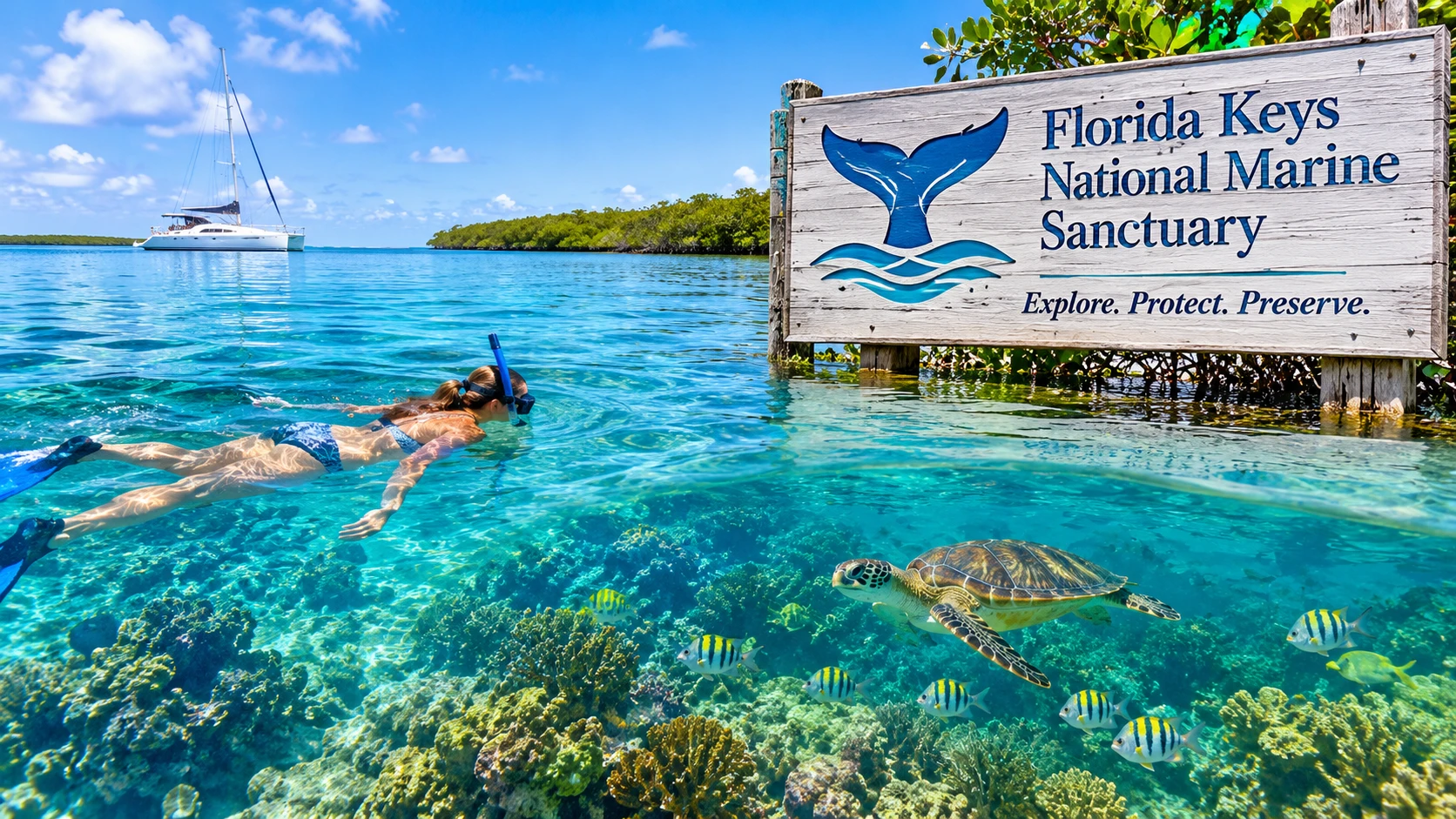
The Florida Keys National Marine Sanctuary protects 3,800 square nautical miles of waters surrounding the Florida Keys, including the barrier reef off Marathon, FL. Visitors must follow designated Sanctuary Preservation Area rules, tie to mooring buoys rather than anchor on coral, use reef-safe sunscreen, and maintain safe diving distances.
Whether you depart from your private dock at Keys Cove at Mile Marker 50 or book a guided snorkeling excursion, understanding sanctuary guidelines ensures a safe, rewarding experience while preserving delicate marine habitats for generations to come.
What Is the Florida Keys National Marine Sanctuary?
The Florida Keys National Marine Sanctuary is a federally protected marine environment extending 3,800 square nautical miles from Biscayne National Park to the Dry Tortugas, safeguarding the world’s third-largest living coral barrier reef system.
Administered by the National Oceanic and Atmospheric Administration (NOAA) in partnership with the State of Florida, the sanctuary encompasses mangrove islands, seagrass meadows, hardbottom communities, and offshore coral reefs. Established in 1990, this vast marine preserve surrounds the entire island chain, surrounding coastal towns like Marathon, FL, known as “The Heart of the Keys.”
The sanctuary protects marine species ranging from sea turtles and manatees to vibrant parrotfish, spiny lobsters, and elkhorn coral. Because the ecosystem faces natural and human pressures, marine zoning management systems establish distinct regulations for specific areas. Understanding these zones helps boaters and swimmers enjoy the water responsibly.
Top Landmark: The Florida Keys National Marine Sanctuary spans nearly 3,800 square nautical miles of ocean, seagrass, and coral reefs surrounding the Florida Keys.
What Are Sanctuary Preservation Areas Around Marathon, FL?
Sanctuary Preservation Areas (SPAs) are fully protected no-take marine zones designed to safeguard shallow coral reef ecosystems like Sombrero Reef and Coffins Patch off the coast of Marathon, FL.
In SPAs, marine life is completely protected from harvesting or disturbance. All fishing, spearfishing, shell collecting, and marine life taking are strictly prohibited within these marked boundaries. Large yellow boundary buoys floating on the water surface mark SPAs, signaling to boaters and divers that no-take regulations are in force.
Off the coast of Marathon, FL, two primary SPAs attract snorkelers and divers from around the world:
- Sombrero Reef: Home to the landmark 142-foot Sombrero Key Light, this shallow spur-and-groove reef system features brain coral, sea fans, and abundant tropical fish. For a detailed guide to visiting this reef with family, explore our Marathon snorkeling guide.
- Coffins Patch: Located northeast of Sombrero Reef, this shallow reef cluster is famous for dense stands of pillar coral and gentle conditions ideal for beginner snorkelers.
Summary of Marine Sanctuary Zones and Rules
| Zone Type | Primary Purpose | Boating & Fishing Rules | Notable Local Example |
|---|---|---|---|
| Sanctuary Preservation Area (SPA) | Protect shallow reef structure and marine biodiversity | No fishing, taking, or anchoring; tie to mooring buoys only | Sombrero Reef, Coffins Patch |
| Ecological Reserve | Protect large, contiguous water column and benthic habitats | Strict no-take zone; entry permits or specific mooring rules apply | Western Sambo, Tortugas Ecological Reserve |
| Special Use / Research Area | Scientific research, restoration, and monitoring | Closed to general public recreation except through permitted research | Tennessee Reef Research Area |
| Wildlife Management Area | Protect sensitive bird nesting, turtle, and shallow water habitats | Idle speed / no wake, no motor, or seasonal closure zones | Marathon flats and island mangrove lakes |
Snorkeling tip: When approaching a Sanctuary Preservation Area like Sombrero Reef, look for large yellow buoys marking the zone perimeter and use blue mooring buoys to secure your vessel.
How Do Mooring Buoys Protect Coral Reefs in the Florida Keys?
Mooring buoys provide secure, free tie-ups for boats near coral reefs, eliminating the need to drop heavy metal anchors that can shatter fragile coral formations.
Dropping an anchor on a living coral reef can destroy decades or centuries of slow coral growth in seconds. To prevent anchor damage, NOAA maintains hundreds of yellow-and-blue mooring buoys at popular reef and dive sites throughout the Florida Keys National Marine Sanctuary.
How to Use a Mooring Buoy Correctly
- Approach Slowly: Approach the buoy from downwind or against the current at idle speed.
- Retrieve the Pickup Line: Use a boat hook to grab the pickup line attached to the buoy.
- Pass Your Own Cleat Line: Pass your boat’s bow line through the pickup line loop and secure both ends to your bow cleat. Never tie the buoy’s pickup line directly to your cleat, as friction can chafe and break the line.
- Allow Proper Slack: Leave at least 12 to 15 feet of line between your boat’s bow and the buoy to absorb wave action.
- Check Capacity: Mooring buoys are designed for vessels up to 65 feet in length under normal sea conditions. During strong winds or high seas, heavy vessels should avoid tying to a single buoy.
If all mooring buoys at a site are occupied, boaters must wait for a buoy to open or move to a sandy seabed area well away from living coral before carefully dropping anchor. Always confirm your anchor lands in clean sand, never on hard bottom or coral.
Pro tip: Guests staying at Keys Cove who reserve a private boat slip at the property’s dock can cruise directly out to Sombrero Reef or Coffins Patch and use the public buoy system for stress-free reef access.
Why Is Standing on or Touching Coral Prohibited?
Touching or standing on coral damages the living tissue and protective mucous layer of delicate coral polyps, exposing the organism to fatal infections and structural decay.
Corals may look like inanimate rocks, but they are colonies of tiny, living animals called polyps. These polyps secrete a hard calcium carbonate skeleton covered by a microscopic skin layer. When swimmers, snorkelers, or divers touch or stand on coral, several destructive processes occur:
- Shedding the Protective Mucous Layer: Touching coral wipes away the protective coating that shields polyps from bacteria, UV radiation, and disease.
- Crushing Living Polyps: Standing on coral crushes polyps against their own sharp calcium carbonate skeletons, killing sections of the colony instantly.
- Kicking Up Sediment: Heavy fin kicking near the sea floor stirs up sand and silt, which settles on coral heads and smothers polyp feeding tentacles.
To keep your body clear of coral formations while floating or swimming:
- Practice buoyancy control and adjust your weight belt before swimming over shallow reef structures.
- Never stand, rest, or sit on any underwater structure unless it is clean sand.
- Keep fins elevated and kick gently with long, controlled leg strokes.
- If you tire while snorkeling, roll onto your back to float or wear a bright flotation vest to rest effortlessly above the reef.
Snorkeling tip: Adjust your mask and snorkel in deep water before moving over shallow reef crests so you never need to reach down to touch the bottom.
What Dive Flag Rules Must Boaters and Snorkelers Follow?
Florida law requires divers and snorkelers to display a red-and-white divers-down flag while in the water, requiring vessel operators to stay at least 300 feet away in open water.
Displaying a divers-down flag alerts passing boaters that people are swimming below the surface, creating a protective buffer around active water sports enthusiasts.
Key Divers-Down Requirements in Florida Waters
- Flag Size: On vessels, the divers-down flag or rigid flag replica must be at least 20 inches by 24 inches and displayed from the highest point of the vessel. On floats or buoys, the flag must be at least 12 inches by 12 inches.
- Open Water Distance: Vessel operators must maintain a minimum distance of 300 feet from a divers-down flag in open water, such as the Atlantic Ocean or Florida Bay surrounding Marathon, FL.
- Narrow Channels: In rivers, inlets, and navigation channels, vessels must stay at least 100 feet away from divers-down flags.
- Idle Speed Requirement: If a vessel must navigate within 300 feet of a flag in open water (or 100 feet in a channel), it must slow to idle speed.
- Swimmer Proximity: Divers and snorkelers must remain within 300 feet of their displayed flag in open water, or within 100 feet in channels.
When returning to your vessel from a swim, lower the dive flag immediately once all swimmers are safely back on board so passing boaters know normal traffic rules resume.
Travel tip: Always keep a dedicated lookout on board while family members snorkel, watching water currents, approaching vessels, and dive flag visibility.
Why Should Visitors Use Reef-Safe Sunscreen in the Florida Keys?
Reef-safe mineral sunscreens formulated with non-nano zinc oxide or titanium dioxide protect human skin without releasing toxic chemicals like oxybenzone, which can cause coral bleaching.
Chemical sunscreens containing ingredients such as oxybenzone, octinoxate, and octocrylene pose significant threats to coral reef ecosystems. As thousands of swimmers enter coastal waters each day, these chemical compounds wash off the skin and accumulate in shallow ocean habitats.
Impact of Chemical Sunscreen Ingredients
- Coral Bleaching: Chemical compounds disrupt coral-algae symbiosis, inducing bleaching at lower sea temperatures.
- DNA Damage: Oxybenzone damages coral DNA, rendering young coral larvae sterile and unable to settle on new reef structures.
- Deformities: Chemical exposure causes structural deformities in developing marine organisms, including sea urchins and reef fish.
To protect the reef, select mineral-based sunscreens labeled “reef-safe” that list non-nano zinc oxide or titanium dioxide as active ingredients. Non-nano particles are large enough that marine organisms cannot ingest them. Applying sun-protective clothing such as long-sleeve UV rashguards, wide-brimmed hats, and polarized sunglasses reduces the need for heavy lotion application altogether.
Pro tip: Apply mineral sunscreen at least 15 minutes before stepping onto the boat so the lotion absorbs into your skin rather than washing straight into the marina basin.
Where Can Visitors Learn More About Marine Conservation in Marathon, FL?
Travelers can explore marine education exhibits, rescue facilities, and local conservation initiatives at landmark destinations throughout Marathon, FL, and through official NOAA sanctuary resources.
Seeing local marine life firsthand helps visitors appreciate the ocean’s delicate balance. During a stay in Marathon, FL, family members of all ages can engage with active conservation efforts at several renowned marine facilities:
- The Turtle Hospital: Located at Mile Marker 48.5, this sea turtle rescue and rehabilitation center offers educational tours showcasing sea turtle rescue, veterinary surgery, and rehabilitation pools. Explore details on our directory listing for The Turtle Hospital.
- Florida Keys Aquarium Encounters: Situated near Marathon, FL, this hands-on marine park features touch tanks, predator reef feedings, and interactive snorkel encounters that teach reef ecology.
- Dolphin Research Center: Located nearby in Grassy Key, this non-profit sanctuary provides educational swims and conservation programs highlighting dolphin and sea lion care.
Learning how researchers rescue marine life and restore coral beds inspires travelers to practice ocean stewardship during their stay. For official sanctuary maps, boating charts, and updated marine regulations, visit the NOAA sanctuary site at `floridakeys.noaa.gov`.
Where to Find Luxury Florida Keys Home Rentals
When planning a marine adventure in the Florida Keys, having a comfortable, central waterfront base makes all the difference. Located at 2264 Overseas Highway, Marathon, FL 33050 (Mile Marker 50), Keys Cove offers upscale 4-bedroom waterfront home rentals equipped with private pools, a private beach area, and private boat slips.
Staying in Marathon, FL puts you in “The Heart of the Keys,” with quick boat access to Sombrero Reef and easy drives to regional highlights.
For directions, explore Keys Cove on Google Maps.
Helpful Travel & Destination Resources
- Browse Keys Cove Waterfront Homes
- Explore Marathon, FL Vacation Rentals
- Where to Stay in the Florida Keys
- Top Things to Do in Marathon, FL
- Family Vacation Guide to Marathon, FL
- Ultimate Florida Keys Itinerary
- Explore the Keys Cove Directory
Frequently Asked Questions
What is the Florida Keys National Marine Sanctuary?
The Florida Keys National Marine Sanctuary is a 3,800-square-nautical-mile protected marine area surrounding the Florida Keys, safeguarding coral reefs, seagrass beds, and marine life from Biscayne National Park to the Dry Tortugas.
Can you fish inside the Florida Keys National Marine Sanctuary?
Recreational fishing is permitted in many areas of the sanctuary under Florida state regulations, but it is strictly prohibited within Sanctuary Preservation Areas (SPAs), Ecological Reserves, and designated Special Use Research Areas.
What are Sanctuary Preservation Areas (SPAs)?
SPAs are shallow, highly protected reef zones marked by yellow boundary buoys where taking any marine life, spearfishing, and anchoring are forbidden to protect coral structures and fish populations.
How do I use a mooring buoy in Marathon, FL?
Approach the yellow-and-blue buoy slowly from downwind, loop your boat’s bow line through the eye of the buoy’s pickup line, and secure both ends of your line to your bow cleat, leaving 12 to 15 feet of slack.
What are the dive flag rules for boaters in Florida?
Boaters must stay at least 300 feet away from displayed divers-down flags in open water and 100 feet away in narrow channels, slowing down to idle speed if forced to pass closer.
What sunscreen should I use when swimming on Florida Keys reefs?
Use mineral-based sunscreens containing non-nano zinc oxide or titanium dioxide, avoiding chemical ingredients like oxybenzone and octinoxate that cause coral bleaching and marine toxicity.
Are pets allowed at Keys Cove vacation rentals?
No, Keys Cove vacation rentals do not allow pets on the property in order to maintain clean, allergy-free accommodations for all guests.